


Finding attractors of continuous-time systems by parameter switching. There are
many different interactions in nature and systems could evolve according
to more than one dynamics for short periods of
time. Therefore, it is reasonable to think that the evolution of some
natural processes could be explained by the alternation of different
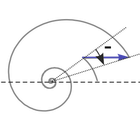
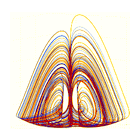
dynamics for relatively short periods of time. RIST's Marius F. Danca
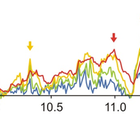
has found that if the control parameter p, of a continuous-time nonlinear system belonging to a large class of systems,
is switched within a set of chosen values in a deterministic or even
random manner, while the underlying model is numerically integrated,
the obtained attractor is a numerical approximation of one of the existing
attractors of the considered system. |
||
Graduate student contest: Best PhD thesis project of the year in computational
game theory. RIST will award a 1000 euros prize for the best PhD thesis
project of the year in computational game theory. Applicants should submit
a summary of their thesis by October 15, 2011, and the full-length thesis
by November 15, 2011. The awards are sponsored by the John Templeton
Foundation. |
||
![]() |
The institute has received a grant from John Templeton Foundation. The USA foundation awarded a grant to the group led by prof. Dumitru Dumitrescu for a project entitled "Towards a conceptual integration of artificial intelligence, game theory and decision theory". | |
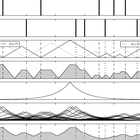
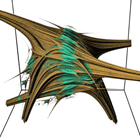
The brain's timescale correlates to the timescale of visual stimuli. Our researchers have found a way to group the recorded activity of multiple neurons
and to measure how quickly they react together to the ever-changing visual
world. They have found that the internal timescale of the brain, i.e.,
the time window needed by neurons to encode a given aspect of the visual
stimulus, is tightly correlated to the external timescale of the visual
stimulus, i.e., the speed with which the visual image on the retina changes. |
||
The Coneural – Max Planck Partner Group
has been renewed. The partnership between the institute's Center for Cognitive and Neural Studies
(Coneural) and the prestigious Max Plank Institute for Brain Research
in Frankfurt, Germany, has been extended for another 2 years (2011-2013),
after an evaluation of the work performed in the previous 3 years.
Peter Gruss, the President of the Max Planck Society (Germany), stated
in the renewal letter: “It is with great pleasure that I take this
opportunity to inform you of the very successful outcome of the mid-term
review of your Partner Group. The review report points out the impressive
scientific output of the Partner Group during the first three years
since its inception. I congratulate you upon this success”. |
||
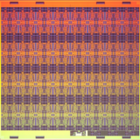
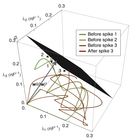
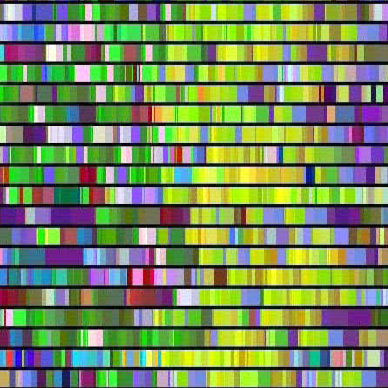
Visualizing how the brain encodes information. The
institute's scientists have developed a special visualization technique
for how multiple neurons fire spikes together to encode information,
by representing the identity of firing patterns of multiple neurons with
color sequences. |
We welcome new scientists that would like to join our institute. Read more.